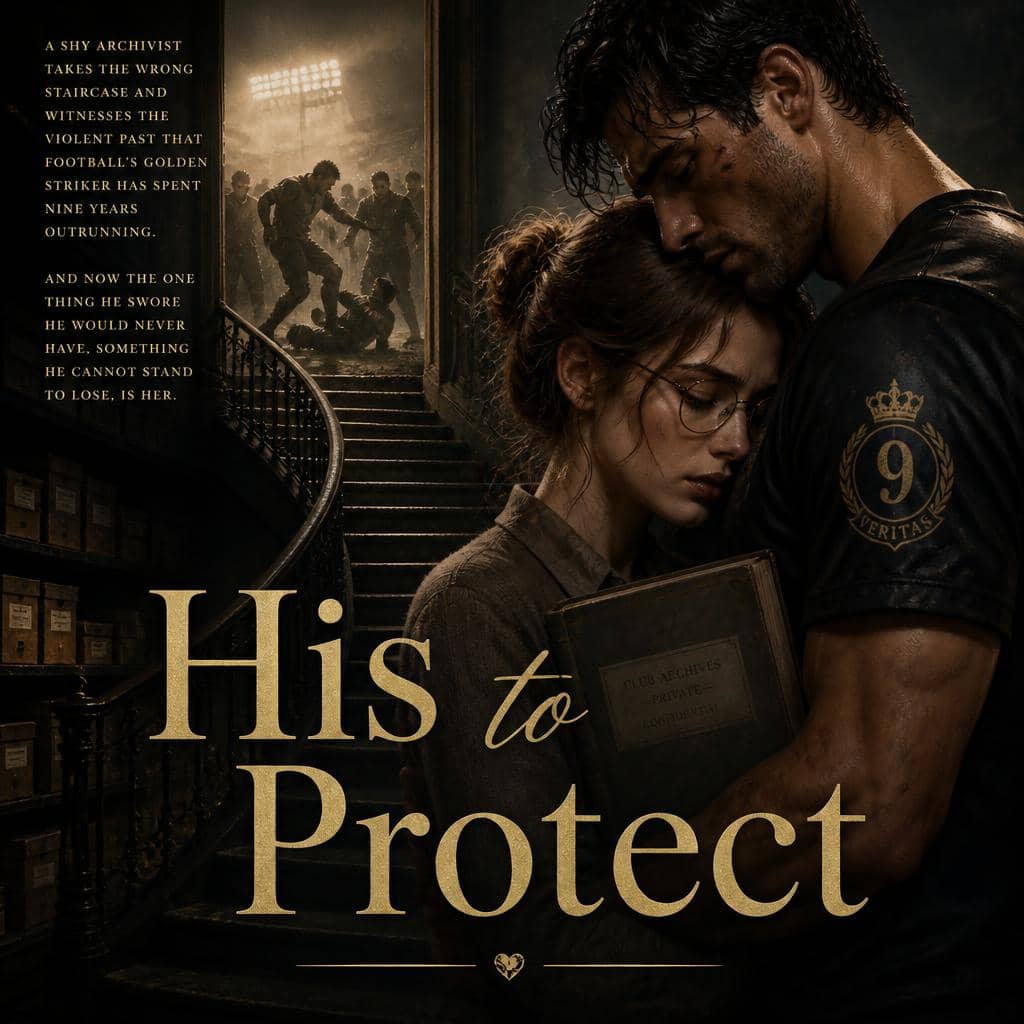
Chapter 1: The Archive
Serena's POV
The best thing about the stadium archive is that on match days it is the quietest place in the entire city.
Eighty thousand people were screaming somewhere above and around me, close enough that I could feel the low roar of it in the floor when Ironclad United did something worth screaming about, and I was three levels down in a windowless room that smelled of old paper and archival glue, cataloguing a box of match programmes from 1974, and I was perfectly, completely happy.
This is a thing people don't understand about me, and I stopped trying to explain it around the time I turned twenty. I don't want the noise. I have never wanted the noise. My whole life, people have treated quiet like a problem to be fixed, like a shy girl is a locked door and the kind thing to do is find a way in. But I'm not a locked door. I'm just quiet. There's a difference, and the archive understands it even if people don't.
“You're still here.”
I jumped, which I hate, and knocked a 1974 programme half off the table, and caught it against my chest before it could crease.
Mr. Adebayo was in the doorway with his coat already on. He runs the museum, which means he is technically my boss, and he is the gentlest man I have ever met, and he has never once made me feel like the quiet was a problem.
“I wanted to finish the box,” I said.
“Serena. It is a match day. The whole world is upstairs.” He said it fondly. “Go home. Or, God forbid, go and watch some football.”
“I like the box.”
“I know you like the box.” He smiled. “Lock up when you're done. Set the alarm. And Serena, take the east stairs tonight, the west exit's got the crowd routing through it, it'll be a crush.”
“East stairs. Alarm. I promise.”
He left, and I went back to 1974, and above me eighty thousand people made the floor tremble, and I catalogued match programmes for another two hours in the most peaceful room in the world, and I did not know that upstairs, at that exact moment, a man I had never spoken to was scoring the goal that would put both our names into the same story.
His name was in the box, actually. That's the small strange thing I think about now. Two of the programmes I filed that night had the name Moretti in them, because he'd been on the cover twice that season, the golden striker, the face of the club, and I filed both of them without a second glance, the way you'd file anything, and slid the box onto the shelf, and turned off the lamp.
I did not care about football. I want that on the record, because of everything that came after. I was an art history student who worked in a stadium because the stadium had an archive and the archive had a job and the job had quiet, and the football was just the noise the building made.
By the time I finished, the roar upstairs had changed. Ironclad had won, I could tell from the pitch of it, a satisfied rolling thunder instead of the sharp anxious spikes of a close game. I stacked my things. I put on my coat. I checked twice that the 1974 box was properly seated on its shelf, because I am the kind of person who checks twice, and I turned off the lamp and stepped out into the corridor and set the alarm with the little code Mr. Adebayo makes me change every month.
East stairs, I reminded myself. Alarm on. East stairs.
And here is the part I have gone over a thousand times since, looking for the moment I could have done something differently, and there isn't one, there's just this: I got to the landing where the east and west stairwells meet, and the east stairwell door had a cleaning cart wedged in front of it, mop bucket and yellow sign and the whole thing, wet floor, closed.
So I took the west stairs.
That's it. That's the whole hinge my life turned on. A wet floor sign and a mop bucket, and a shy girl who did what she was told right up until she couldn't, and took the other door.
The west stairwell let out near the players' entrance, on the service side, where the crowd had already thinned to nothing because the players' cars go out a different gate. It was cold. My footsteps were loud. I pulled my coat tighter and put my head down and walked fast, the way I always walk, small and quick and please-don't-notice-me, toward the far door and the bus stop and home.
And I heard a voice say, low and vicious, in a tone I had never heard a human being use in real life, “You don't get to walk away from this. Not from us. You know that.”
I should have kept walking.
I stopped.
Chapter 2: The Golden Striker
Dante's POV
I scored in the seventy-first minute and I felt nothing, which is how I know I'm playing well.
People think you feel something when the ball goes in. They think there's joy. There's joy afterward, manufactured, for the cameras, arms out, badge kissed, the whole liturgy. But in the moment itself, the good moments, there's nothing at all. Just a cold clean quiet where the striker used to be, the ball already gone before the keeper's moved, and eighty thousand people making a noise you don't hear because you've already turned to jog back to the halfway line.
The quiet is the whole point. On the pitch I am the calmest I ever am, because on the pitch the rules are simple and everyone can see them and nothing happens in the dark.
“Moretti! Dante! Quick word for the broadcast?”
“No,” I said, and kept walking down the tunnel, and the interviewer laughed the nervous laugh they all learn to laugh, because a Moretti no is a known quantity, it's practically a catchphrase, and tomorrow some paper would run three hundred words about my legendary reluctance to speak, and none of them would ever guess the actual reason, which is that I have spent fifteen years making sure I never say a single word into a microphone that could be twisted into a thread and pulled.
You give them nothing. Nothing is the only thing they can't use.
Coach Reyes caught my good shoulder in the tunnel, beaming.
“That's twelve,” he said. “Twelve in fifteen. You know the last man to do that at this club?”
“No.”
“Neither do I, I made it up, but it sounded impressive and you actually smiled, so it was worth it.” Reyes is a good man. He thinks my silence is focus. He thinks the whispers are jealousy. He has managed me for two seasons and he has no idea, none, and I intend to keep it that way, because Reyes is the kind of decent that danger uses as a doorway, and I've spent enough of my life watching decent people get hurt through the door I left open. “Get iced, get changed. And Dante, the final's three weeks out. Whatever you're doing, keep doing it.”
“I will.”
I got iced. I got changed. I did not shower until the room had mostly cleared, because I don't like the way the young ones look at the scars, the old ones, the ones that don't come from football, and I have gotten very good over the years at being the last one out, at moving through the world in the empty spaces where nobody's watching.
That's the habit that saved her life, as it turns out. Being the last one out.
I took the service corridor because the service corridor is empty after a match, the players' cars gone, the crowd routed out the front, just concrete and cold light and the long walk to the gate where my own car waited. I had my bag over my good shoulder and my hood up and my mind already three weeks ahead on the final, and I came around the corner by the west stairwell and there were four of them.
I knew them before I saw their faces. That's the thing about a past like mine. You know the shape of it in the dark. The way they stood. The particular stillness of men who are waiting for you and want you to know they were waiting.
“Dante,” the nearest one said, and smiled, and I had not heard that voice in nine years and my whole body went cold and quiet, the pitch quiet, the nothing quiet. “You're a hard man to catch alone these days. All these cameras. All these people who love you.”
“You shouldn't be here.”
“No,” he agreed. “We shouldn't. And yet.” He spread his hands. “Marco sends his regards. He wanted me to remind you, in person, that some debts don't clear just because a man gets famous. If anything, famous makes them larger.”
“I paid what I owed. Nine years ago. I'm out.”
“Nobody's out,” he said, gently, the way you'd correct a child. “You of all people should know that. You know exactly what happens to the people who think they're out. You know it better than anyone.” His eyes moved to the scar on my jaw and then away, deliberate, and I understood the reference and my hand closed into a fist at my side. “So here's how it's going to be. You don't get to walk away from this. Not from us. You know that.”
And that was when I heard it.
A small sound. Behind me and to the left, back toward the stairwell. The scuff of a shoe on concrete, quickly stilled.
Everything in me went to ice.
Because the four of them heard it too, and four heads turned toward the stairwell at once, and there, frozen on the third step with one hand on the rail and her whole face white with the specific terror of someone who has just understood that she is somewhere she should not be, was a girl.
Small. Dark coat. A student's canvas bag over one shoulder. Enormous frightened eyes fixed on the man who had just been explaining, in detail, how debts get collected.
She had heard everything.
And now the four of them had seen her face.
“Well,” the nearest one said softly, turning back to me with a new and terrible interest, “and who is this?”
End of sample. Full manuscript available on request.
Want a novel like this with your name on it?
I write full-length fiction in your voice, ready to publish, and your project stays 100% confidential.
Start a Project